
MSc research (by research) · University of Moratuwa, Sri Lanka · August 2023 – September 2024
My MSc showed, with a single experiment and a meso-scale finite element model, why ultra-thin woven composites lose bending stiffness as they are folded to large curvatures — and what that means for designing deployable space structures.
| Thesis | Simulation of non-linear bending behavior of ultra-thin woven composites (repository) |
| Supervisor | Prof. Chinthaka Mallikarachchi, Deployable Structures Laboratory, Department of Civil Engineering |
| Funding | National Research Council of Sri Lanka |
| Main paper | Gamage et al. (2026), Composite Structures 383, 120079 — doi:10.1016/j.compstruct.2026.120079 |
Why it matters
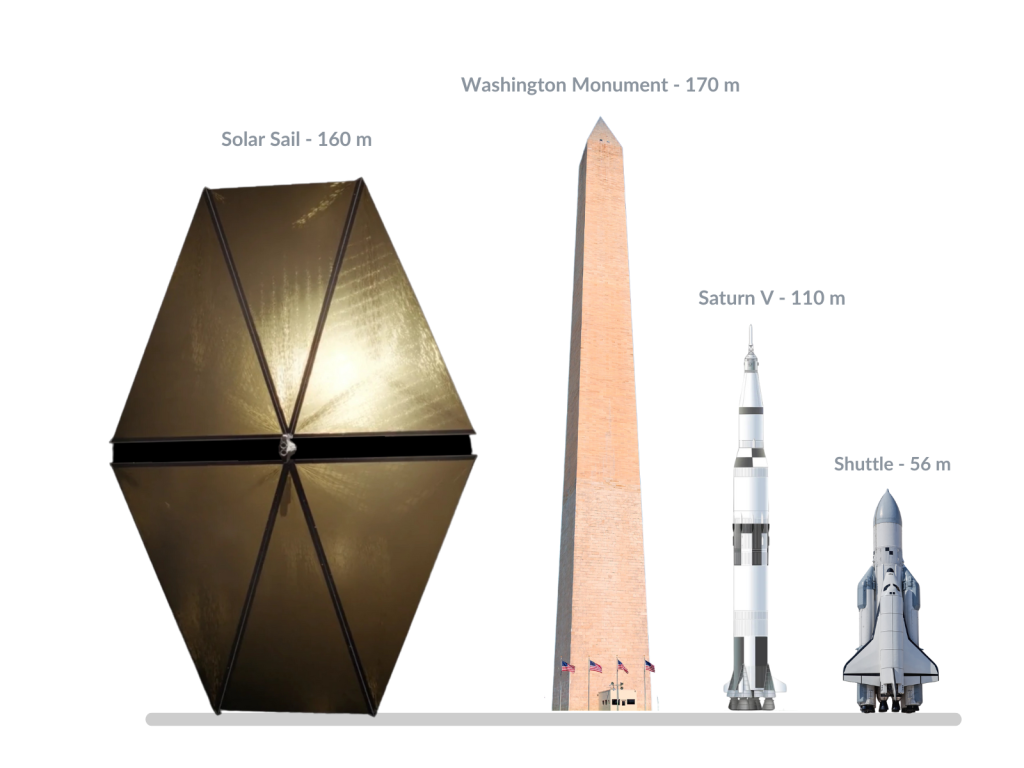
Launch vehicles have little room for payload, so large structures such as solar sails, reflector antennas and booms are folded for launch and deployed in space. Ultra-thin woven fibre composites make this possible: they are light and flexible enough to fold without heavy mechanical hinges.
Failures in deploying satellite appendages can end a mission, and testing these structures in realistic conditions is expensive and impractical. Engineers therefore rely on simulation — but only if the models capture how the material really behaves when it is folded tightly.
The problem
Experiments on one- and two-ply woven composites show a clear drop in bending stiffness, of about 20%, at large curvatures. Classical lamination theory does not predict this and can overestimate bending properties by 200–400% for laminates with fewer than three plies.
Experiments
Several tests characterise the bending behaviour and failure of these laminates: the four-point bending test, the platen folding test and the column bending test. The column bending test, carried out in collaboration with Caltech (California Institute of Technology), measures the full moment–rotation response using digital image correlation, from the initial stiffness to failure, in a single procedure.
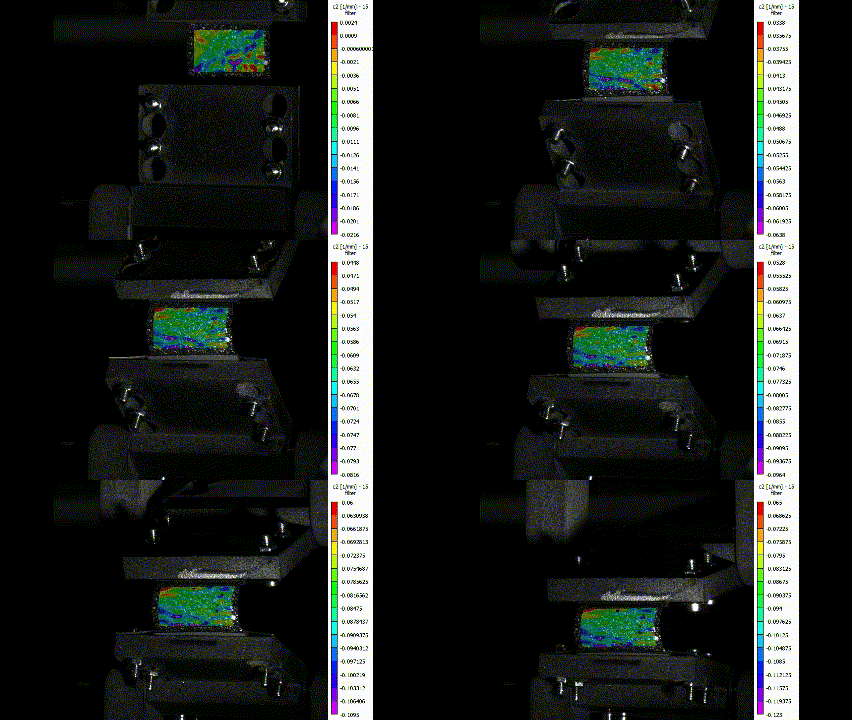
I evaluated several approaches to reconstruct the bending response from these measurements and compared them with the four-point bending and platen folding data.
Multiscale modelling
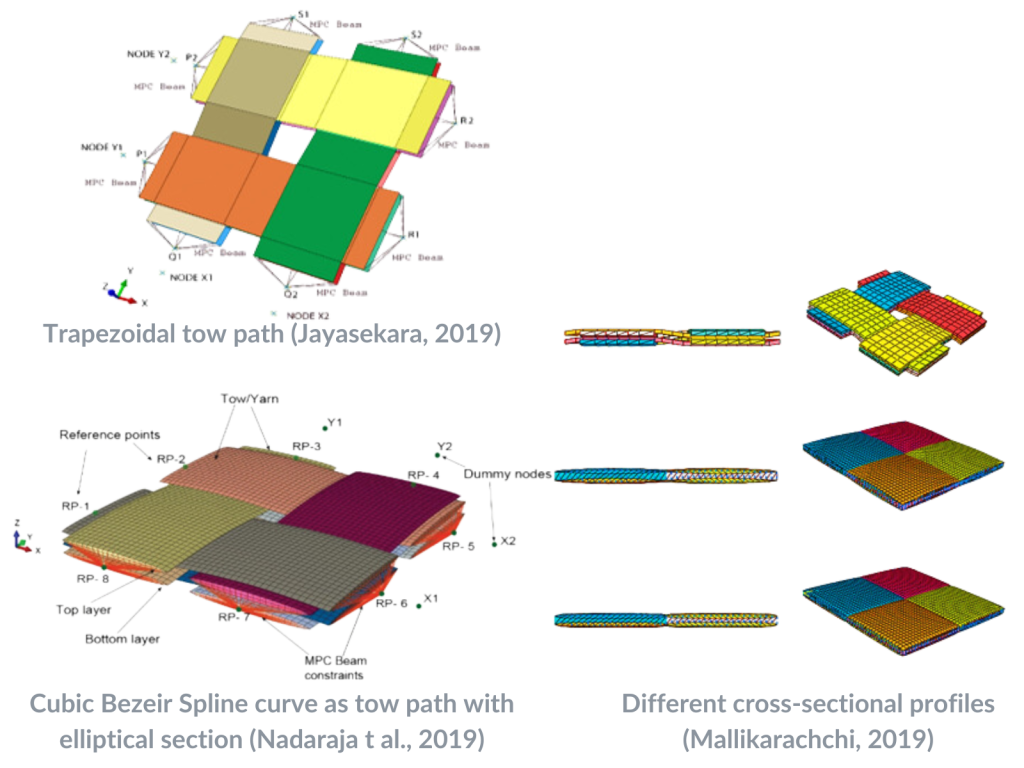
To explain the experimental response, I built a representative unit cell model of a two-ply plain-weave laminate that captures the woven architecture at the meso-scale. The model accounts for:
- unit cell size and tow geometry (cross-section, tow path, element choice);
- fibre alignment and the interaction between tows;
- periodic boundary conditions;
- geometric non-linearity at large deformation and the material non-linearity of the tows.
The meso-scale response was then passed to macro-scale structural simulations through a user-defined section stiffness matrix.
Results
- The model captures the non-linear moment–curvature response measured in column bending tests.
- Updating the stiffness matrix during the simulation, rather than keeping it constant, changes the predicted stiffness reduction at large curvatures significantly — and is essential for predicting folding forces.
- The work confirms the reported stiffness reduction experimentally and gives a validated route to simulate it for design.
Publications from this work
- Gamage, E., Weerasekara, L., Weerasinghe, U., Herath, S., Wijesuriya, H. S., & Mallikarachchi, C. (2026). Non-linear bending response of ultra-thin woven fibre composites. Composite Structures, 383, 120079.
- Weerasekara, L., Silva, N., Gamage, E., Herath, S., & Mallikarachchi, C. (2025). Predicting nonlinear bending behaviour of ultra-thin woven fibre composites. 6th Indian Planetary Science Conference (IPSC 2025).
- Blog: analysis of the column bending test