
PhD research · CEMEF, Mines Paris – PSL University · October 2024 – December 2027 (expected)
I am developing numerical methods that let a computer predict how metal separates into a chip at the tip of a cutting tool — fast and accurately enough to run dozens of machining simulations and compare them with real cutting tests.
| Thesis | Development of numerical modelling methods for simulating chip formation in machining |
| Lab | CEMEF (UMR CNRS 7635), Mines Paris – PSL University, Sophia Antipolis, France |
| Supervisors | Katia Mocellin (CSM team), Daniel Pino Muñoz (MSR team), Yancheng Zhang (2MS team) |
| Project | ANR CENTURION (ANR-22-CE08-0028-02), with LABOMAP and LEM3 |
| Started | October 2024 |
Why it matters
Inconel 718 is a nickel superalloy used where parts must survive heat and high stress, such as aerospace engines. Printing it by Selective Laser Melting (SLM) allows complex shapes, but the printed part still has to be machined, and the machined surface largely decides how long the part will last.
The CENTURION project aims to produce high-quality SLM Inconel 718 components by machining alone, without heat treatment. Choosing the right cutting parameters requires simulations that predict the surface the cut leaves behind — and today’s machining models struggle with the hardest part: the material physically separating to form the chip.
The project and my role
CENTURION brings together three laboratories. LABOMAP and LEM3 develop constitutive, friction and contact models for SLM Inconel 718 from experiments. My thesis at CEMEF builds the orthogonal cutting model in the FORGE finite element software that brings these models together, and develops the numerical methods it needs:
- an explicit time-integration scheme, because machining is highly dynamic and implicit solvers become too costly;
- a phase-field damage approach to represent the material separating as the chip forms;
- automatic mesh refinement to resolve the cutting zone where it matters;
- validation against experimental machining tests carried out within the project.
Progress so far
Year 1 — A benchmark cutting model
To have a baseline for the new methods, I reproduced a well-known 2D orthogonal cutting simulation from the literature in 3D, using FORGE’s implicit solver.
With the standard Johnson–Cook law, the model produced a continuous chip — but experiments show a segmented one. I implemented the modified Johnson–Cook law of Calamaz et al. (2008), which adds strain softening, as a user-defined subroutine in FORGE. The model then produced a segmented chip that agrees closely with the experimental data in the literature.
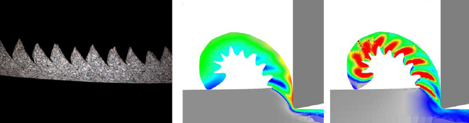
In parallel, after a detailed study of FORGE’s finite element algorithm and source code, I developed a predictor–corrector explicit time-marching scheme for its mechanical solver — the foundation for the second year.
Year 2 — Building an explicit solver for machining
I then extended the explicit solver step by step, verifying each ingredient on benchmark problems before moving to the next.
1. Plasticity. To keep the speed of a fully explicit solver while staying accurate, I integrated the inelastic stresses with a Next Increment Corrects Error (NICE) scheme. In benchmarks it was clearly more accurate and efficient than the classical forward Euler scheme: the consistency condition was driven to zero within a few increments and stayed there, keeping the stress state on the yield surface.
2. Volumetric locking. Linear tetrahedral elements lock when plastic flow is nearly incompressible. I added an anti-locking treatment based on the average nodal volume formulation of De Micheli (2009) and validated it on the Taylor bar impact test: results agree well with ABAQUS/Explicit and with published data.
3. Contact. I implemented an explicit penalty-based contact method and tested it on a series of benchmark contact cases. Choosing the penalty coefficient is the known difficulty of this approach and took careful calibration, but the formulation reproduced the benchmarks and is ready for the cutting model.
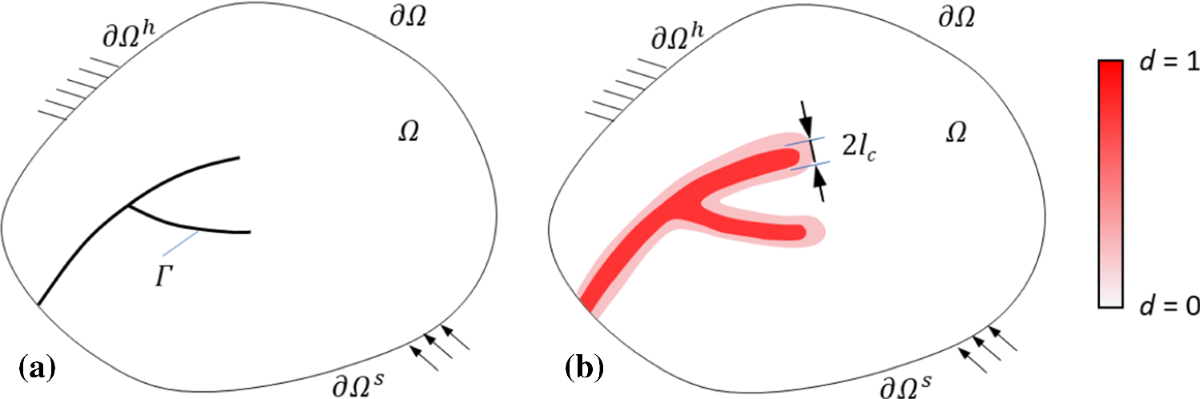
4. Fracture with phase field. Finally, I introduced phase-field damage into the explicit framework and compared parabolic, hyperbolic and elliptic damage evolution laws for accuracy and computational cost. I am currently applying the formulation to brittle fracture.
What comes next
- Extend the phase-field framework from brittle to ductile fracture, the regime relevant to metal cutting.
- Add automatic mesh refinement around the cutting zone.
- Integrate the constitutive and friction models from LABOMAP and LEM3 for SLM Inconel 718.
- Run the full explicit chip-formation simulations and validate them against the project’s machining experiments.
Skills used in this project
Finite element method development · explicit time integration · elastoplastic stress integration · contact mechanics · phase-field fracture · constitutive modelling (Johnson–Cook) · FORGE source code and user subroutines · ABAQUS/Explicit · Python · Fortran · MATLAB · cloud computing for parallel simulation campaigns
Get in touch
I am open to industry R&D roles from early 2028 — in aerospace, advanced manufacturing, simulation software and numerical-methods development — in Germany, France, Switzerland or the USA. I am also glad to discuss collaborations on machining simulation, explicit finite element methods and fracture modelling.